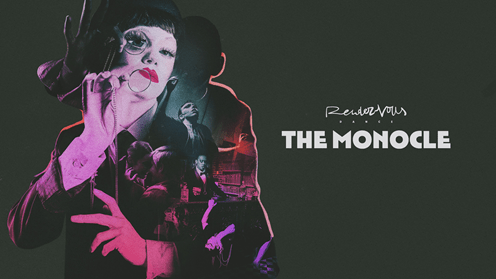
It’s not often I get to visit a lesbian cabaret club on a Wednesday night, or any night for that matter, so, when asked to this one I couldn’t refuse, and I am glad I didn’t. This wasn’t any old lesbian cabaret club, it was Le Monacle and not any old Wednesday, it was a one-off night when the club was taken out of mothballs for a last hoorah. I was transported back to the inter-war years in Paris where decadence was rife and, in the title of the song from 1934, anything goes. Although ostensibly a dance piece, it was a multi discipline work with a chanteuse/mistress of ceremonies and a modicum of audience participation.
The action began with the MC and a British Sign Language interpreter taking to the stage to warn about the use of mobile phones and let us know how to access the audio description channel. This sounds a bit incongruous for a show set in the early 1940s, however, the whole point of the piece is to emphasise safe places for those who might otherwise feel excluded, so, apart from meaning that the production would not be interrupted by ring tones, it isolated us from the outside world.
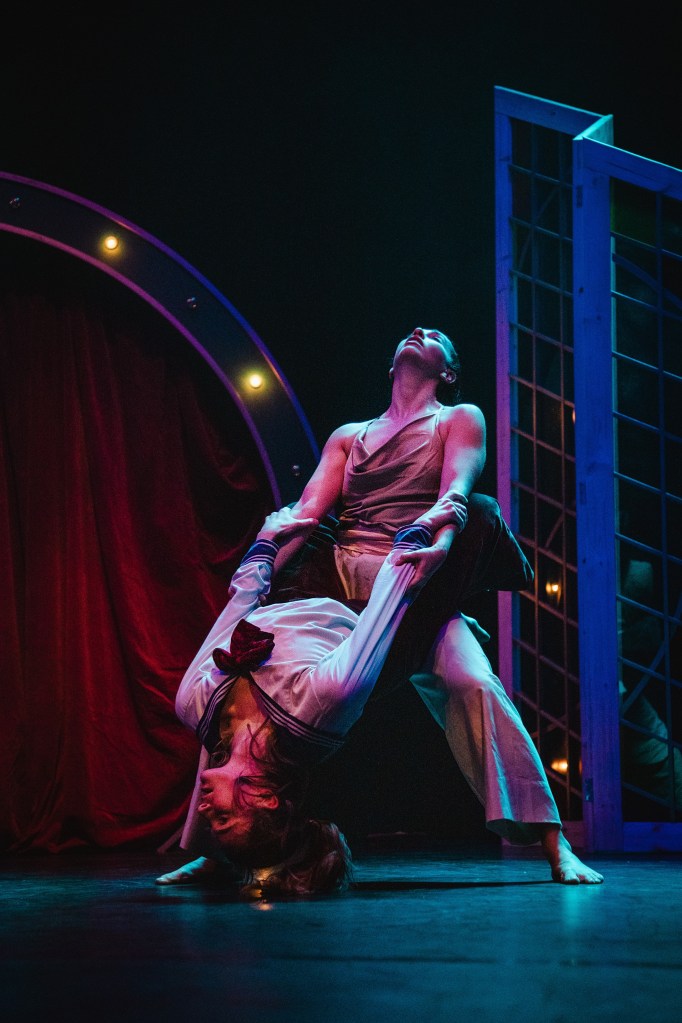
The staff then began to filter in and remove the dust sheets from the bar and lay the tables; not only those on stage, but one at the front of the auditorium. Atop the tables were placed specimen vases containing a white carnation as well as napkins etc, the significance of which was that a button-hole comprising that flower along with the wearing of a monocle by a woman, was the signal of her sexual proclivity.
One of the employees was a door minder who carefully vetted and searched anyone who was not a regular, in order to make sure that the club was indeed a safe space where the members and guests could enjoy themselves in whatever way the chose without harassment or judgment.
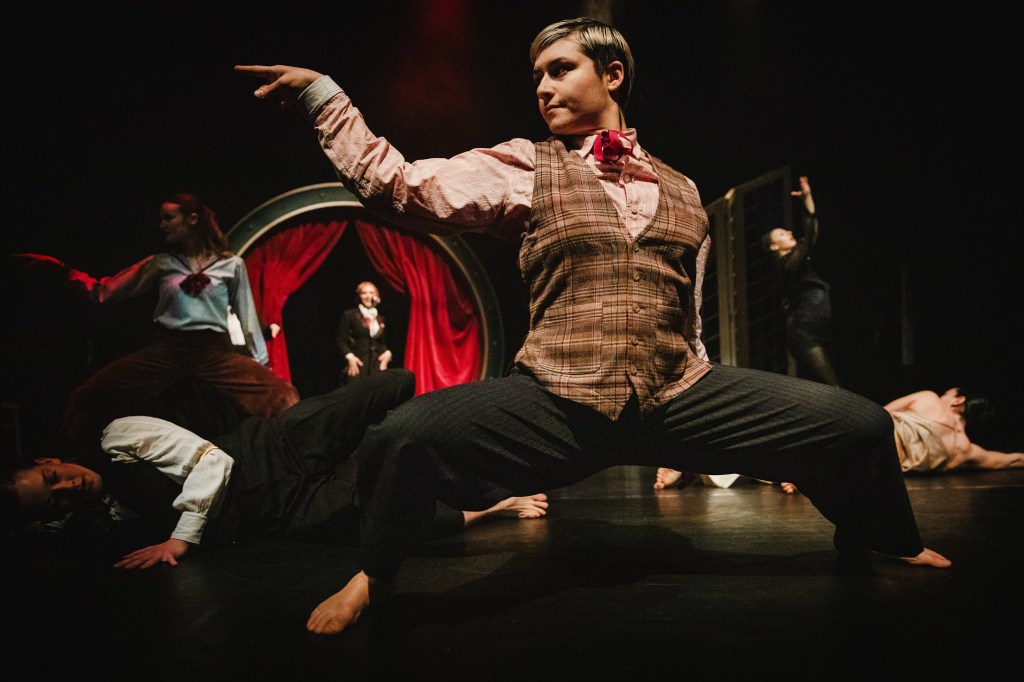
The place began to fill up with habitués along with a stranger who, after the interrogation and frisking at the door, was let in to mingle as she chose. The dancing began with a kind of sizing-up ritual which developed into full eroticism as the evening, and cocktails, progressed. and the newcomer began to feel accepted. The dancing moves throughout were very evocative of the mood to be conveyed and superbly executed.
Le Monocle was a real Parisian establishment which was abruptly closed by the occupying German regime in 1941, as represented by a ghostly black spectre trying to gain entry, but prevented from doing so by the bouncer. The first half ended when the dancer of this part burst into the room and the whole theatre blacked out.
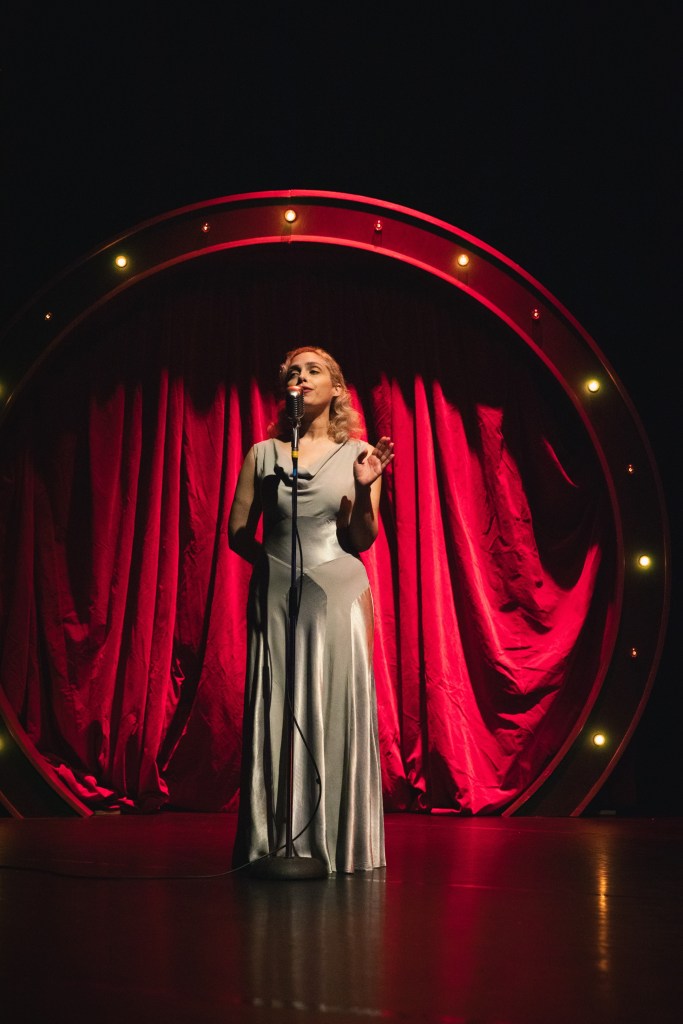
There then followed something I have never experienced before, instead of the curtain falling and everyone filing out to the bar, loo, ice cream station or all three, the singer came out on stage to perform a cabaret act consisting of appropriate songs of the time and place. I therefore decided to take a quick comfort break and bring a strawberry tub back to my seat and enjoy the music, which I did. It was during this performance that one of the dancers came into the audience and asked a woman to dance, an offer she accepted, and the two took to the stage for an impromptu twirl.
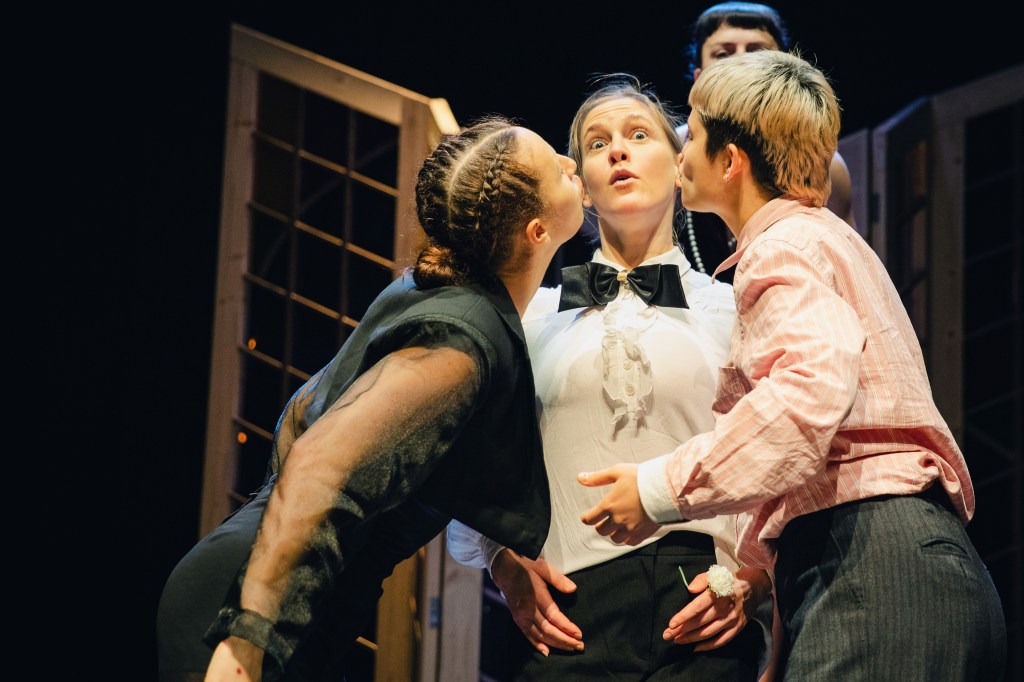
The mood changed somewhat in the second half, which began with the cocktail waitress mixing two drinks, placing them on a tray and delivering them down the steps at the front of the stage to the aforementioned table at the front of the auditorium. On her way back she was wolf-whistled and had her bottom slapped by a customer who was becoming the worse for wear.
There then followed a strange sequence which I couldn’t decide whether was real or a parody. The bouncer and the woman causing the disturbance donned false moustaches and began to do a fight dance, officiated over by the cocktail waitress, who looked the part as her bar uniform was a white shirt with black trousers and matching bow tie, similar to the outfit of a boxing referee. After a tame start it began to get more violent until forcibly stopped by the other customers. I think it may have been a man-bashing interlude where they used the facial hair to re-gender whilst reducing their behaviour to the violence normally associated with men, but I can’t be sure.
I feel, however, that I must stand up for the majority of my fellow men here as the episode reminded me of an incident in the mid 1960s when, as a schoolboy, I worked in a coffee bar in Leeds, which was open late at night, making my employment highly illegal for someone my age, but I didn’t mind as I enjoyed it. As homosexuality was still illegal and the premises were in a cellar, when the pubs frequented by the gay community – although not yet referred to by that soubriquet – closed, a representative would pop down to see if it seemed safe to let everyone know they could come in. It used to be a blast when they did. One night, however, two lesbians had a disagreement which soon turned into a proper fight, and a more vicious altercation I have not witnessed before or since. It seemed as though it would continue until one of them was killed or seriously hurt. Fortunately there were enough staff members and workers from other coffee bars, who would pop in when their places had shut, to eventually split the pair up. It was also fortuitous that they had taken their altercation outside into the side alley as, if it had remained in the cellar it would have turned into a cage fight and blood bath. That is the case for the defence M’Lord.
Photograph by Cave and Sky
When the stage fight had ended, a lot more peacefully and less messily, than the one above, the evening drew to a close, but not before the spectre had reappeared and gained entry to the club. This time it crawled along the edge of the stage and into the front row where the table was, much to the surprise of those seated there. It went back to the main performing area, where another menacing apparition, this time in white, or silver, it was difficult to tell, was trying to gain admission.
I took these figures to represent the impending escalation of the war and resultant demise of the club, which was also signified by the cabaret singer regaling us with some more songs whilst the staff replaced the dust sheets for the final time. Hence one last soirée.
There were six main dancers; Alyssa Lisle, Coralie Calfond, Natassa Argyropoulou, Bonita “Ruth” Howard, Zara Phillips and Mutyat Anibaba, all of whom were brilliant. The singer was Imogen Banks, who interpreted the songs in the Parisian fashion à la Edith Piaf, a combination of singing and acting, and the whole piece was interpreted into British Sign Language by Caroline Ryan who became an integral part of the action whilst doing so.
The Artistic Director was Mathieu Geffré, the Associate Director, Andrew Gardiner and the Composer James Keane.
This was one of the most interesting and well presented shows I have seen in my, admittedly brief, foray into the world of dance, where I am still learning the language. Should you wish to know more about Rendezvous Dance then please go to https://www.rendez-vousdance.com/ontour which gives you the tour dates for this production, which has only one more date and that is tonight, 6th March at Dance City, Newcastle, but is being performed again at Wilton’s Music Hall, London on 15th and 16th May, so get along if you can. There are also details of another piece on tour in Australia.
To see what is coming to Harrogate Theatre it is https://www.harrogatetheatre.co.uk/performances/
By the way, thanks to this show, I have also learned how to disguise my man boobs!
Photographs (of the production, not my man boobs) by Rhiannon Banks, except where stated.
 Tyke It To The Limit